If you share being born into Gen X with me, you remember a time without cellphones. You remember when a phone was attached to the wall, when directions came from paper maps, and when many of us wondered why anyone would need a computer in their pocket that talked to us by itself.
And yet, here we are.
Today, that “computer we still call a cellphone” helps us check the weather, take photos, answer emails, navigate traffic, pay bills, manage calendars, and stay connected with our communities. Things change, whether we are enthusiastic about it or not. Over time, we adapt, start seeing the benefits, and, hopefully, continue asking the right questions about ethics, privacy, and how new tools should be used.
Generative artificial intelligence is one of those changes.
For Augusta Recreation and Parks, generative AI is not a replacement for employees, experience, professional judgment, or public accountability. It is a support tool. It can help us research, draft, summarize, brainstorm, edit, and create preliminary concepts more efficiently. It can help a small communications team prepare clearer public information, help staff think through program descriptions, and help organize ideas for grants, events, outreach, and internal planning. But every final decision, every official communication, and every public-facing product remains the responsibility of our staff.
That distinction matters.
Across the parks and recreation profession, AI is already being discussed as a practical tool for daily work. Rec Technologies describes AI as a potential “secret weapon” for departments dealing with staffing shortages, heavy inboxes, seasonal programming, and constant administrative demands (Rec Technologies, Inc., 2025). Its examples are familiar to anyone who has worked in recreation: writing program descriptions, responding professionally to unhappy constituents, summarizing public feedback, preparing common front-desk answers, and creating basic promotional visuals.
BerryDunn makes a similar point, noting that parks and recreation agencies have long been asked to “do more with less” (Hegreness, 2024). In that context, generative AI can help with social media posts, newsletters, press releases, reports, grant applications, research synthesis, brainstorming, and graphic design. The value is not that AI magically knows our community. It does not. The value is that it can help staff get from a blank page to a workable first draft faster.
That is often where the real benefit is.

For example, staff may already know the details of a youth clinic, senior program, pool schedule, community event, or athletic league. AI can help turn those details into a first draft for a webpage, flyer, caption, FAQ, or email. Staff then verify the facts, adjust the tone, remove anything inaccurate, and make sure the final message reflects Augusta Recreation and Parks, not a generic template.
AI can also help us think. It can help compare possible program names, simplify complicated information, reorganize a long memo, summarize public comments into themes, or suggest ways to explain a facility closure in a clearer and more customer-friendly way. In a department that serves residents across many programs, facilities, and neighborhoods, that kind of support can save time without changing who is ultimately responsible.
Image generation is another area where AI can be useful, but it requires even more caution. AI-generated images may help brainstorm flyer concepts, event themes, or illustrative ideas. A resource from Hegreness Consulting demonstrates image-generation examples for parks and recreation, including event imagery, program imagery, and playground concepts, while also warning that “additional due diligence is advised” before using AI artwork in an organization (Hegreness Consulting, 2023).
That caution is especially important for a public parks and recreation agency. We cannot use AI-generated images in a way that misleads the public, misrepresents actual facilities, implies participation by real children or residents without consent, or creates confusion between a conceptual image and a real photograph. If AI assists with imagery, the final product must still be reviewed, labeled when appropriate, and consistent with our media release, privacy, and communication standards.
The 2025 Perception & Impact of AI in Parks & Recreation report reinforces that the profession is still in an early stage. The report focuses on adoption, hesitation, and opportunity in the parks and recreation field, which reflects the practical reality for many agencies: staff see potential, but they also need trust, training, policies, and clear boundaries before AI can be used responsibly (Next Practice Partners, 2025).
That sounds about right. The issue is not simply whether AI can produce text or images. It can. The harder question is whether an agency has the policies, training, judgment, and review practices needed to use it responsibly.
Augusta, Georgia has recently adopted a generative AI policy that provides the framework for that responsible use. The policy allows generative AI for appropriate business purposes, including general research using publicly available information, summarizing non-confidential materials, brainstorming, editing, proofreading, outlining, and formatting assistance. It also makes clear that AI tools used on the City’s network require Information Technology review and approval.
The same policy draws clear lines. Employees may not enter confidential, sensitive, or personally identifiable information into public AI tools. Employees may not upload Augusta documents, records, or datasets into a generative AI platform unless that platform has been approved. AI may not independently make decisions involving employment actions, discipline, law enforcement, emergency response prioritization, legal determinations, judicial decisions, technical implementations, financial authorizations, or budget approvals. The policy also prohibits AI note-taking apps for City meetings because of privacy, security, and data-protection concerns.
Within Augusta Recreation and Parks, those citywide requirements are reinforced by our Social Media and Digital Communication Policy. Our department’s policy states that AI tools, including large language models and generative systems, may support research, drafting, content development, and creative design. It also states that AI must be used solely as an assistive tool, and that all AI-assisted content must be reviewed, revised, and approved by department staff before publication or dissemination.
In practical terms, that means AI does not publish for us. AI does not approve for us. AI does not decide what is accurate, lawful, appropriate, or aligned with the department’s mission. Staff do.
The department also requires verification. AI-generated content can contain inaccuracies, omissions, outdated information, fabricated sources, or misleading statements. Our policy requires staff to verify information before release and to comply with applicable legal, privacy, and data governance standards. When practicable, content created or edited with AI assistance may be identified with the statement: “Created with the assistance of AI and reviewed by Augusta Recreation & Parks.”
That last part is important. Transparency is not an apology. It is a public trust practice.
The purpose of identifying AI-assisted work is not to diminish the work or suggest that staff were not involved. It is to be honest about the tools used in the process. Just as a photographer might use editing software, a planner might use mapping software, or a communications staff member might use a grammar tool, AI can be one part of the workflow. What matters is whether the work is accurate, ethical, reviewed, and accountable.
The caveats are real.

AI can be wrong. It can sound confident while being inaccurate. It can reflect bias in the data it was trained on. It can generate images that underrepresent certain groups or reinforce stereotypes. It can create privacy concerns if staff enter sensitive information into public tools. It can tempt organizations to move too quickly, rely too heavily on automation, or blur the line between assistance and decision-making.
BerryDunn warns that generative AI is “not without limitations” and emphasizes human oversight, privacy, data security, ethics, and the need to treat AI as a complement to human creativity rather than a substitute for it (Hegreness, 2024). PRPS takes a similar practical view, describing AI as a partner rather than a threat and emphasizing curiosity, humility, and responsible learning as parks and recreation professionals adapt to new tools (Tierney, 2025).
That is the balance we are trying to strike.
We should not pretend AI does not exist. Our residents are using it. Our vendors are using it. Our peer agencies are exploring it. Our employees will encounter it in common workplace tools, search engines, phones, office software, and design platforms. Avoiding the conversation does not eliminate the risk. It only makes the use less visible, less consistent, and less governed.
At the same time, public agencies cannot adopt technology the way private companies sometimes do. We operate in a public trust environment. We are responsible for residents, children, seniors, public spaces, public records, accessibility, privacy, and fairness. Our standard cannot be “move fast and see what happens.” Our standard has to be responsible, transparent, reviewed, and human-centered.
That is why our approach is simple:
AI may assist. Staff decide.
AI may draft. Staff verify.
AI may suggest. Staff judge.
AI may help create. Staff remain accountable.
As parks and recreation professionals, our work is still about people. It is about safe programs, welcoming facilities, maintained parks, public service, community trust, and the everyday quality of life in Augusta. Generative AI can help us communicate faster, organize information better, and think through ideas more efficiently. But it cannot replace local knowledge, professional ethics, lived experience, or the human relationships that make public service work.
So, this is not a declaration that AI is good or bad. It is a conversation starter.
Where do you think generative AI can help local parks and recreation agencies serve residents better? Where should the limits be? What uses would build trust, and what uses would make you uncomfortable?
Those are the questions worth asking now, while we still have the opportunity to shape the tool instead of letting the tool shape us.
A view behind the curtain:
How This Blog Post Was Developed
This blog post was developed through a combined human and AI-assisted workflow. The process began with the general idea of explaining how Augusta Recreation and Parks uses generative artificial intelligence in a practical, transparent, and responsible way. The goal was not simply to describe AI as a new technology, but to connect it to the daily work of a public recreation agency, including communications, program promotion, research, drafting, accessibility, public trust, and staff accountability.
The first step was idea development and framing. A personal opening note was drafted around the experience of growing up before cellphones became common, using that shift as a familiar comparison for how people adapt to new technologies over time. This helped establish the article as a conversation starter rather than a technical policy statement.
The second step was research. Publicly available articles and reports about generative AI in parks and recreation were reviewed, including sources from Rec Technologies, Next Practice Partners, Hegreness Consulting, BerryDunn, and the Pennsylvania Recreation and Park Society. Those resources were used to identify common themes: AI as a support tool for drafting and communication, its usefulness in program promotion and administrative work, its potential for image generation and brainstorming, and the need for caution around accuracy, bias, privacy, and overreliance.
The third step was policy review. Augusta’s citywide Generative AI Policy and the Augusta Recreation and Parks Social Media and Digital Communication Policy were reviewed to make sure the blog post accurately reflected internal rules. The post was then shaped around the department’s actual standard: AI may assist with research, drafting, editing, content development, and creative design, but staff must review, verify, revise, approve, and remain responsible for the final product.
The fourth step was drafting. Generative AI was used to help organize the blog structure, convert notes and policy language into readable public-facing language, and create an initial draft. The draft was then revised to better reflect the department’s tone, clarify the difference between AI assistance and human decision-making, and include both the benefits and risks of AI use.
The fifth step was citation and source correction. The public sources were formatted into APA-style references, and the blog post was updated with in-text citations. The internal Augusta policy documents were referenced in the body of the post but excluded from the public reference list because they are not publicly available.
The sixth step was proofreading and wording refinement. The article was reviewed for readability, tone, source support, policy consistency, and public communication standards. Additional offline wording adjustments were made to ensure the final article sounded appropriate for Augusta Recreation and Parks and did not read like a generic AI-generated template.
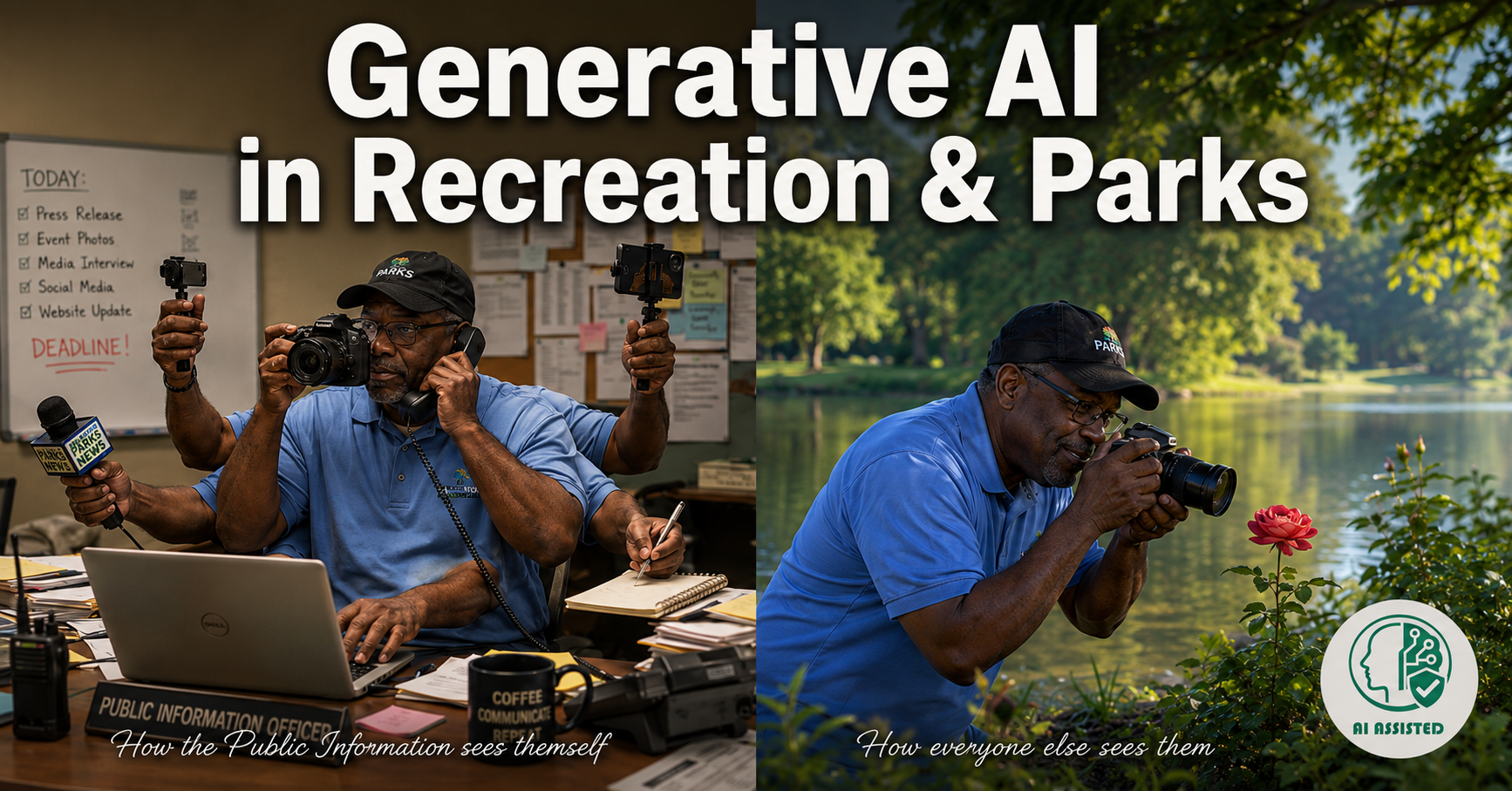
The seventh step was image development. AI-assisted image generation was used to create a featured image and supporting “intermission” images for the blog post. Those images were developed to illustrate the contrast between public information work as it often feels internally, how it may appear externally, how AI can help turn staff knowledge into draft content, and how staff review helps prevent errors, bias, and misrepresentation.
The eighth step was image correction and quality control. Several generated images required correction because of inaccurate wording, incorrect department naming, incorrect or improperly placed logos, and visual issues that did not meet the intended standard. The images were revised to use “Recreation and Parks” correctly, incorporate the appropriate Augusta Recreation and Parks branding, and include the correct AI Assisted logo where applicable. When image generation did not reliably correct a logo placement issue, manual image editing was used to cover the incorrect mark and place the correct AI Assisted logo.
The online AI-assisted portion of the work took approximately 2.5 hours, including research organization, drafting, citation formatting, image prompting, image revisions, and final AI disclosure language. The offline staff portion, including review, judgment calls, wording refinement, policy interpretation, visual review, and final approval, took approximately 1.5 additional hours. In total, the complete blog post package required approximately 4 hours from idea development through final text, citations, images, corrections, proofreading, and publication-ready refinement.
AI Assistance Disclosure
Written by Frank Rost / Augusta Recreation and Parks, with drafting, editing, organization, and image-generation assistance from OpenAI ChatGPT, GPT-5.5 Thinking, accessed June 12, 2026. Final content was reviewed, revised, verified, and approved by Augusta Recreation and Parks.
Internal Policy Sources Referenced
The discussion of Augusta’s internal AI requirements is based on Augusta, Georgia’s citywide Generative AI Policy and the Augusta Recreation and Parks Department Social Media and Digital Communication Policy. These internal policy documents are not included in the public reference list because they are currently not publicly available.
References
Hegreness Consulting. (2023, November 11). AI image generation for parks & recreation. https://hegreness.net/ai-image-generation-for-parks-recreation/
Hegreness, R. (2024, September 25). Generative AI in parks and recreation. BerryDunn. https://www.berrydunn.com/news-detail/generative-ai-in-parks-and-recreation
Next Practice Partners. (2025). 2025 perception & impact of AI in parks & recreation. https://benextpractice.com/pdf/2025-perception-impact-parks-rec.pdf
Rec Technologies, Inc. (2025, April 17). 5 ways to use AI in parks and rec. Rec. https://partner.rec.us/blog/5-ways-to-use-ai-in-parks-and-rec
Tierney, M. A. (2025, September 8). Staying ahead: Embracing AI to thrive in parks and recreation. Pennsylvania Recreation and Park Society. https://prps.org/posts/staying-ahead-embracing-ai-to-thrive-in-parks-and-recreation