Augusta Rec & Parks Insider is the official blog of the Augusta Recreation & Parks Department, dedicated to keeping the community informed about parks, programs, and events in Augusta, GA. Stay connected with updates, stories, and ways to get involved in making our city more active and vibrant!

  • Generative AI in Parks and Recreation: A Tool, a Responsibility, and a Conversation Worth Having

    If you share being born into Gen X with me, you remember a time without cellphones. You remember when a phone was attached to the wall, when directions came from paper maps, and when many of us wondered why anyone would need a computer in their pocket that talked to us by itself.

    And yet, here we are.

    Today, that “computer we still call a cellphone” helps us check the weather, take photos, answer emails, navigate traffic, pay bills, manage calendars, and stay connected with our communities. Things change, whether we are enthusiastic about it or not. Over time, we adapt, start seeing the benefits, and, hopefully, continue asking the right questions about ethics, privacy, and how new tools should be used.

    Generative artificial intelligence is one of those changes.

    For Augusta Recreation and Parks, generative AI is not a replacement for employees, experience, professional judgment, or public accountability. It is a support tool. It can help us research, draft, summarize, brainstorm, edit, and create preliminary concepts more efficiently. It can help a small communications team prepare clearer public information, help staff think through program descriptions, and help organize ideas for grants, events, outreach, and internal planning. But every final decision, every official communication, and every public-facing product remains the responsibility of our staff.

    That distinction matters.

    Across the parks and recreation profession, AI is already being discussed as a practical tool for daily work. Rec Technologies describes AI as a potential “secret weapon” for departments dealing with staffing shortages, heavy inboxes, seasonal programming, and constant administrative demands (Rec Technologies, Inc., 2025). Its examples are familiar to anyone who has worked in recreation: writing program descriptions, responding professionally to unhappy constituents, summarizing public feedback, preparing common front-desk answers, and creating basic promotional visuals.

    BerryDunn makes a similar point, noting that parks and recreation agencies have long been asked to “do more with less” (Hegreness, 2024). In that context, generative AI can help with social media posts, newsletters, press releases, reports, grant applications, research synthesis, brainstorming, and graphic design. The value is not that AI magically knows our community. It does not. The value is that it can help staff get from a blank page to a workable first draft faster.

    That is often where the real benefit is.

    For example, staff may already know the details of a youth clinic, senior program, pool schedule, community event, or athletic league. AI can help turn those details into a first draft for a webpage, flyer, caption, FAQ, or email. Staff then verify the facts, adjust the tone, remove anything inaccurate, and make sure the final message reflects Augusta Recreation and Parks, not a generic template.

    AI can also help us think. It can help compare possible program names, simplify complicated information, reorganize a long memo, summarize public comments into themes, or suggest ways to explain a facility closure in a clearer and more customer-friendly way. In a department that serves residents across many programs, facilities, and neighborhoods, that kind of support can save time without changing who is ultimately responsible.

    Image generation is another area where AI can be useful, but it requires even more caution. AI-generated images may help brainstorm flyer concepts, event themes, or illustrative ideas. A resource from Hegreness Consulting demonstrates image-generation examples for parks and recreation, including event imagery, program imagery, and playground concepts, while also warning that “additional due diligence is advised” before using AI artwork in an organization (Hegreness Consulting, 2023).

    That caution is especially important for a public parks and recreation agency. We cannot use AI-generated images in a way that misleads the public, misrepresents actual facilities, implies participation by real children or residents without consent, or creates confusion between a conceptual image and a real photograph. If AI assists with imagery, the final product must still be reviewed, labeled when appropriate, and consistent with our media release, privacy, and communication standards.

    The 2025 Perception & Impact of AI in Parks & Recreation report reinforces that the profession is still in an early stage. The report focuses on adoption, hesitation, and opportunity in the parks and recreation field, which reflects the practical reality for many agencies: staff see potential, but they also need trust, training, policies, and clear boundaries before AI can be used responsibly (Next Practice Partners, 2025).

    That sounds about right. The issue is not simply whether AI can produce text or images. It can. The harder question is whether an agency has the policies, training, judgment, and review practices needed to use it responsibly.

    Augusta, Georgia has recently adopted a generative AI policy that provides the framework for that responsible use. The policy allows generative AI for appropriate business purposes, including general research using publicly available information, summarizing non-confidential materials, brainstorming, editing, proofreading, outlining, and formatting assistance. It also makes clear that AI tools used on the City’s network require Information Technology review and approval.

    The same policy draws clear lines. Employees may not enter confidential, sensitive, or personally identifiable information into public AI tools. Employees may not upload Augusta documents, records, or datasets into a generative AI platform unless that platform has been approved. AI may not independently make decisions involving employment actions, discipline, law enforcement, emergency response prioritization, legal determinations, judicial decisions, technical implementations, financial authorizations, or budget approvals. The policy also prohibits AI note-taking apps for City meetings because of privacy, security, and data-protection concerns.

    Within Augusta Recreation and Parks, those citywide requirements are reinforced by our Social Media and Digital Communication Policy. Our department’s policy states that AI tools, including large language models and generative systems, may support research, drafting, content development, and creative design. It also states that AI must be used solely as an assistive tool, and that all AI-assisted content must be reviewed, revised, and approved by department staff before publication or dissemination.

    In practical terms, that means AI does not publish for us. AI does not approve for us. AI does not decide what is accurate, lawful, appropriate, or aligned with the department’s mission. Staff do.

    The department also requires verification. AI-generated content can contain inaccuracies, omissions, outdated information, fabricated sources, or misleading statements. Our policy requires staff to verify information before release and to comply with applicable legal, privacy, and data governance standards. When practicable, content created or edited with AI assistance may be identified with the statement: “Created with the assistance of AI and reviewed by Augusta Recreation & Parks.”

    That last part is important. Transparency is not an apology. It is a public trust practice.

    The purpose of identifying AI-assisted work is not to diminish the work or suggest that staff were not involved. It is to be honest about the tools used in the process. Just as a photographer might use editing software, a planner might use mapping software, or a communications staff member might use a grammar tool, AI can be one part of the workflow. What matters is whether the work is accurate, ethical, reviewed, and accountable.

    The caveats are real.

    AI can be wrong. It can sound confident while being inaccurate. It can reflect bias in the data it was trained on. It can generate images that underrepresent certain groups or reinforce stereotypes. It can create privacy concerns if staff enter sensitive information into public tools. It can tempt organizations to move too quickly, rely too heavily on automation, or blur the line between assistance and decision-making.

    BerryDunn warns that generative AI is “not without limitations” and emphasizes human oversight, privacy, data security, ethics, and the need to treat AI as a complement to human creativity rather than a substitute for it (Hegreness, 2024). PRPS takes a similar practical view, describing AI as a partner rather than a threat and emphasizing curiosity, humility, and responsible learning as parks and recreation professionals adapt to new tools (Tierney, 2025).

    That is the balance we are trying to strike.

    We should not pretend AI does not exist. Our residents are using it. Our vendors are using it. Our peer agencies are exploring it. Our employees will encounter it in common workplace tools, search engines, phones, office software, and design platforms. Avoiding the conversation does not eliminate the risk. It only makes the use less visible, less consistent, and less governed.

    At the same time, public agencies cannot adopt technology the way private companies sometimes do. We operate in a public trust environment. We are responsible for residents, children, seniors, public spaces, public records, accessibility, privacy, and fairness. Our standard cannot be “move fast and see what happens.” Our standard has to be responsible, transparent, reviewed, and human-centered.

    That is why our approach is simple:

    AI may assist. Staff decide.

    AI may draft. Staff verify.

    AI may suggest. Staff judge.

    AI may help create. Staff remain accountable.

    As parks and recreation professionals, our work is still about people. It is about safe programs, welcoming facilities, maintained parks, public service, community trust, and the everyday quality of life in Augusta. Generative AI can help us communicate faster, organize information better, and think through ideas more efficiently. But it cannot replace local knowledge, professional ethics, lived experience, or the human relationships that make public service work.

    So, this is not a declaration that AI is good or bad. It is a conversation starter.

    Where do you think generative AI can help local parks and recreation agencies serve residents better? Where should the limits be? What uses would build trust, and what uses would make you uncomfortable?

    Those are the questions worth asking now, while we still have the opportunity to shape the tool instead of letting the tool shape us.

    A view behind the curtain:

    How This Blog Post Was Developed

    This blog post was developed through a combined human and AI-assisted workflow. The process began with the general idea of explaining how Augusta Recreation and Parks uses generative artificial intelligence in a practical, transparent, and responsible way. The goal was not simply to describe AI as a new technology, but to connect it to the daily work of a public recreation agency, including communications, program promotion, research, drafting, accessibility, public trust, and staff accountability.

    The first step was idea development and framing. A personal opening note was drafted around the experience of growing up before cellphones became common, using that shift as a familiar comparison for how people adapt to new technologies over time. This helped establish the article as a conversation starter rather than a technical policy statement.

    The second step was research. Publicly available articles and reports about generative AI in parks and recreation were reviewed, including sources from Rec Technologies, Next Practice Partners, Hegreness Consulting, BerryDunn, and the Pennsylvania Recreation and Park Society. Those resources were used to identify common themes: AI as a support tool for drafting and communication, its usefulness in program promotion and administrative work, its potential for image generation and brainstorming, and the need for caution around accuracy, bias, privacy, and overreliance.

    The third step was policy review. Augusta’s citywide Generative AI Policy and the Augusta Recreation and Parks Social Media and Digital Communication Policy were reviewed to make sure the blog post accurately reflected internal rules. The post was then shaped around the department’s actual standard: AI may assist with research, drafting, editing, content development, and creative design, but staff must review, verify, revise, approve, and remain responsible for the final product.

    The fourth step was drafting. Generative AI was used to help organize the blog structure, convert notes and policy language into readable public-facing language, and create an initial draft. The draft was then revised to better reflect the department’s tone, clarify the difference between AI assistance and human decision-making, and include both the benefits and risks of AI use.

    The fifth step was citation and source correction. The public sources were formatted into APA-style references, and the blog post was updated with in-text citations. The internal Augusta policy documents were referenced in the body of the post but excluded from the public reference list because they are not publicly available.

    The sixth step was proofreading and wording refinement. The article was reviewed for readability, tone, source support, policy consistency, and public communication standards. Additional offline wording adjustments were made to ensure the final article sounded appropriate for Augusta Recreation and Parks and did not read like a generic AI-generated template.

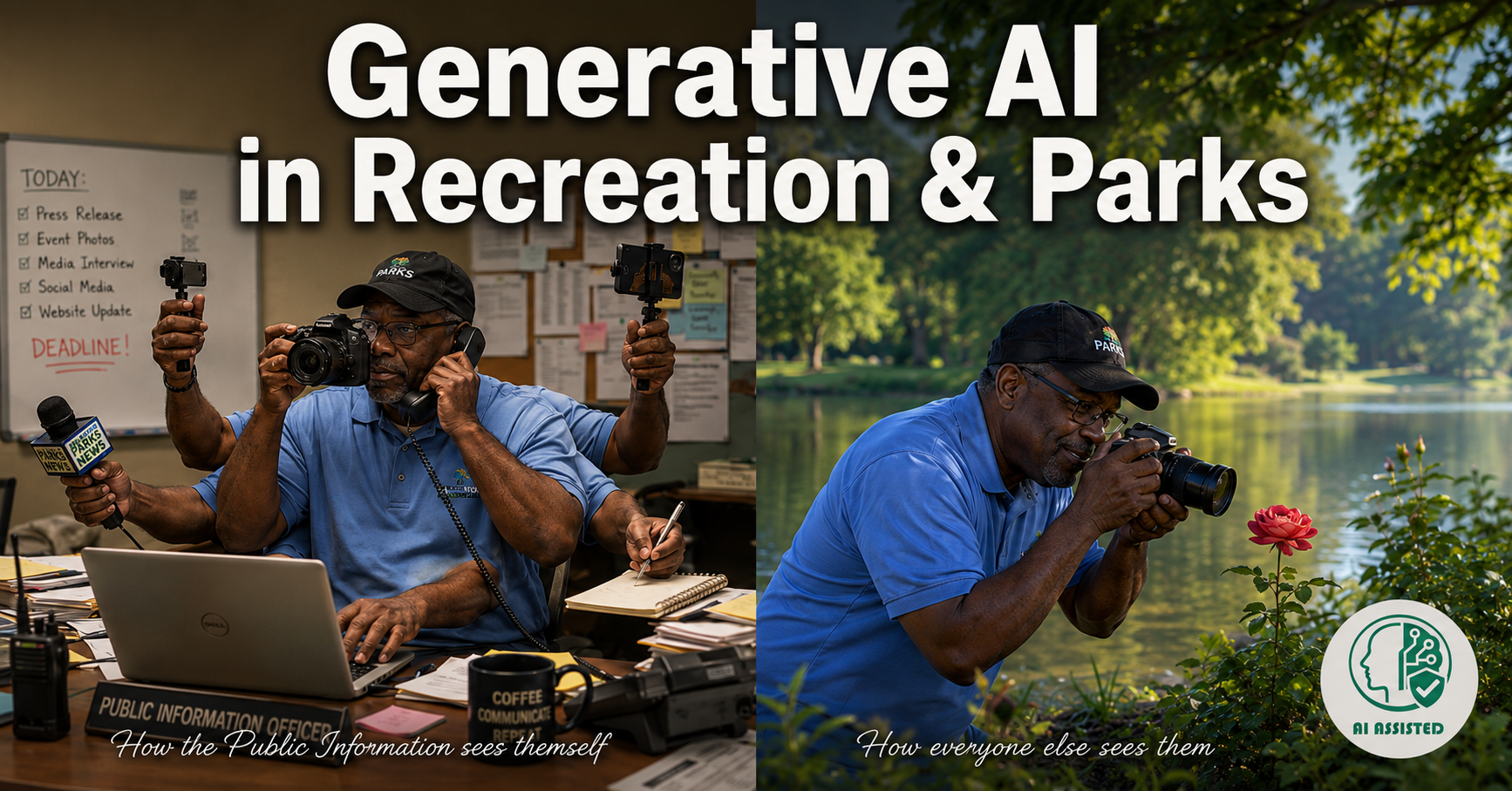
    The seventh step was image development. AI-assisted image generation was used to create a featured image and supporting “intermission” images for the blog post. Those images were developed to illustrate the contrast between public information work as it often feels internally, how it may appear externally, how AI can help turn staff knowledge into draft content, and how staff review helps prevent errors, bias, and misrepresentation.

    The eighth step was image correction and quality control. Several generated images required correction because of inaccurate wording, incorrect department naming, incorrect or improperly placed logos, and visual issues that did not meet the intended standard. The images were revised to use “Recreation and Parks” correctly, incorporate the appropriate Augusta Recreation and Parks branding, and include the correct AI Assisted logo where applicable. When image generation did not reliably correct a logo placement issue, manual image editing was used to cover the incorrect mark and place the correct AI Assisted logo.

    The online AI-assisted portion of the work took approximately 2.5 hours, including research organization, drafting, citation formatting, image prompting, image revisions, and final AI disclosure language. The offline staff portion, including review, judgment calls, wording refinement, policy interpretation, visual review, and final approval, took approximately 1.5 additional hours. In total, the complete blog post package required approximately 4 hours from idea development through final text, citations, images, corrections, proofreading, and publication-ready refinement.

    AI Assistance Disclosure

    Written by Frank Rost / Augusta Recreation and Parks, with drafting, editing, organization, and image-generation assistance from OpenAI ChatGPT, GPT-5.5 Thinking, accessed June 12, 2026. Final content was reviewed, revised, verified, and approved by Augusta Recreation and Parks.

    Internal Policy Sources Referenced

    The discussion of Augusta’s internal AI requirements is based on Augusta, Georgia’s citywide Generative AI Policy and the Augusta Recreation and Parks Department Social Media and Digital Communication Policy. These internal policy documents are not included in the public reference list because they are currently not publicly available.

    References

    Hegreness Consulting. (2023, November 11). AI image generation for parks & recreation. https://hegreness.net/ai-image-generation-for-parks-recreation/

    Hegreness, R. (2024, September 25). Generative AI in parks and recreation. BerryDunn. https://www.berrydunn.com/news-detail/generative-ai-in-parks-and-recreation

    Next Practice Partners. (2025). 2025 perception & impact of AI in parks & recreation. https://benextpractice.com/pdf/2025-perception-impact-parks-rec.pdf

    Rec Technologies, Inc. (2025, April 17). 5 ways to use AI in parks and rec. Rec. https://partner.rec.us/blog/5-ways-to-use-ai-in-parks-and-rec

    Tierney, M. A. (2025, September 8). Staying ahead: Embracing AI to thrive in parks and recreation. Pennsylvania Recreation and Park Society. https://prps.org/posts/staying-ahead-embracing-ai-to-thrive-in-parks-and-recreation

  • Flexible Summer Camp Options for Kids in Augusta

    Summer break has a way of sneaking up fast. One minute it’s spring, the next minute school is out and families across Augusta are figuring out how to keep kids active, engaged, and having a good time all summer long. That is exactly where Augusta Recreation & Parks Summer Day Camps come in.

    Our camps are built around a simple idea. Summer should be fun, structured, and meaningful. Each day is filled with activities that keep kids moving and engaged, from arts and crafts to games, group activities, and time outdoors. Campers also get to enjoy weekly field trips and pool days, which tend to become the highlight of the week.

    The schedule is designed to work for families. The main camp day runs from 9:00 AM to 3:00 PM, with options to extend the day if needed. Early Risers starts at 7:00 AM, and Afternoon Adventures runs until 6:00 PM, giving parents and guardians flexibility before and after the core program.

    Another advantage is accessibility. With multiple locations across Augusta, families can choose a site that is convenient to their home or daily routine. Each location follows the same structure and standards, so participants receive a consistent experience no matter where they attend.

    Beyond the activities, the focus of the program is on creating a safe and supportive environment. Staff work to ensure that every participant feels included, respected, and encouraged to participate. The program emphasizes positive social interaction, teamwork, and building confidence, all while keeping the experience centered on fun.

    The 2026 Summer Day Camp season runs throughout June and July, with scheduled breaks to accommodate holidays.

    For families looking for a reliable, engaging, and affordable summer option, Augusta Recreation & Parks offers a program that combines structure with fun and provides a strong foundation for a great summer experience.

    Additional information and registration are available here:
    https://www.augustaga.gov/3450/Summer-Day-Camps

  • First Podcast Episode: How Fees and Funding Really Work

    Why do some recreation programs have fees while others don’t? How are those fees set, and how do taxpayer dollars fit into the picture?

    In our first episode of the Augusta Recreation & Parks Podcast, we take listeners behind the scenes to explain cost recovery, a concept that plays a key role in how public recreation programs are funded, priced, and sustained.

    Cost recovery helps us understand the true cost of running programs and how those costs are shared between participant fees and public support. In this episode, we break it all down in a clear, straightforward way, focusing on transparency, fairness, and community impact.

    What you’ll learn in this episode:

    • What “cost recovery” really means
    • Why some programs charge fees and others don’t
    • The real costs behind recreation programs that often go unseen
    • How taxpayer support helps keep programs accessible
    • Why transparency matters in public services

    From staffing and facilities to utilities and citywide support services, this episode offers insight into the many layers involved in delivering high-quality recreation opportunities across Augusta.

    Whether you’re a resident, parent, participant, or staff member, this episode provides helpful context into how Recreation & Parks works to balance access, affordability, and sustainability.

    🎧 Listen now on Spotify:
    https://open.spotify.com/episode/4pdLFQN1XRuCwdItouRKlU

    🔗 Explore our public cost recovery calculator:
    https://www.augustaga.gov/3413/Cost-Calculator

  • One Year Down, Ready For 2026

    Have you spent any time in an Augusta park or community center this past year? Then you already know the story. You have heard the laughter on the playgrounds, seen families spread out picnic blankets, enjoyed one of our many programs, and watched kids sprint across fields like the championship depends on it. Or you felt that quiet moment of calm that only a walk under tall trees can give you.

    Rather than counting time by dates on a calendar, many of us at Recreation & Parks see the year as a series of seasons. Each one brings a different rhythm, a different energy, and a different reason to show up. And here’s what we are looking forward to:

    Winter: The Calm Before The Crowd

    Winter is when things slow down just enough for us to catch our breath. Programs continue, community centers stay active, and seasonal events like the Christmas Tree Light Up bring people together when the days are short and the nights come early. Behind the scenes, however, winter is anything but quiet. This is when plans take shape and the foundation for the year ahead is built. Youth basketball schedules receive their final polish, coaches and teams are getting ready. Community centers plan their activities and prepare so that when activity ramps up, everything is ready to go. Maintenance staff can focus on repairs and get ready for the inevitable grass cutting season. It may not be the loudest season but it’s the most important one.

    Spring: Everything Comes Back To Life

    Spring is when Augusta stretches back outdoors. Families return to playgrounds, trails, and neighborhood events. Yes, the Masters are coming, but you can also feel the shift as the city moves outside and stays there. At the Department, it’s the season of fresh starts. New programs launch, annual traditions like the Easter Egg hunts return, and volunteer efforts remind us how much people care about their public spaces. Spring carries a sense of optimism that sets the tone for everything that follows.

    Summer: Long Days, Loud Parks, And Full Calendars

    Summer is when recreation goes into full swing. The Candlelight Music Series, movies under the stars, food trucks, all coming back. Splash pads, summer pools, camps, youth athletics, Independence Day, and picnics in the park: they all turn our parks and community centers into gathering places from morning to night. Community centers buzz with activity, athletic fields stay busy, and parks become the backdrop for memories that will be talked about long after the season ends.

    It’s busy. It’s loud. It’s joyful. And it’s recreation at its best: people together, unplugged, and fully present in their community.

    Fall: Traditions And Keeping The Momentum

    As the air cools, fall keeps the energy going. Sports seasons continue, annual community events return, and parks remain active well into the evening. It’s also the season to listen closely and reflect. What worked well? What can be enhanced? What does our community want more of? It’s a season of momentum and reflection, helping shape the next cycle of programming and improvements. And let’s not forget it’s Halloween, with tricks and treats at almost every community center.

    Looking Ahead: Same Mission, New Ideas

    As we step into another year, our focus stays simple and steady. Take care of the parks and create programs that matter. Make recreation accessible, welcoming, and fun. Keep listening to the people we serve. Some things will feel familiar and others will feel new. But the goal remains the same: parks and programs that feel like they belong to everyone.

    Thank You For Being Part Of It

    If you attended an event, signed a kid up for a program, volunteered your time, partnered with us, or simply enjoyed a quiet moment in a park, you were part of this story. We are grateful for every visit, every game, every class, and every shared experience. Here’s to another year of full parks, busy community centers, and seasons worth remembering.

  • Beneath the Shade Trees: The Stories Our Cemeteries Tell

    When most people hear “Augusta Recreation and Parks,” they think of playgrounds, ball fields, walking trails, and community centers. It might be surprising to learn that our department is also closely connected to some of Augusta’s oldest burial grounds. Over the past several weeks, we have updated and expanded the city’s cemetery pages. The goals were simple. Make information easier to find. Make the history more accurate. And help people see these cemeteries not only as places of grief, but as places of memory, art, and community.

    First, a clear note about who does what. Augusta Recreation and Parks is responsible for the administrative side of the three active city cemeteries: Magnolia, Cedar Grove, and West View. Our staff schedules services, supports families and funeral homes, and maintains cemetery records and historic documentation. Daily grounds work is different. Routine tasks such as mowing, trimming around markers, and general clean up are performed by crews from the Richmond County Correctional Institution. If you see a maintenance issue in one of Augusta’s cemeteries, the best way to report it is through Augusta 311. They pass the request directly to the right team so it can be addressed as quickly as possible.

    Cemeteries as outdoor history books

    Augusta’s cemeteries tell the story of the city from the early 1800s to today. Each burial ground reflects a different part of that story, from early riverfront days and military posts to mill villages, hilltop neighborhoods, and long standing African American communities. The updated Cemetery History page now gives a short overview of each cemetery, along with its address and a summary of how it came to be.

    Magnolia Cemetery began as part of a plantation on the edge of the city and grew into a large public burial ground that covers about sixty acres. It includes sections for different faiths and community groups, and even has a brick wall that once formed part of Augusta’s Civil War defenses. Today it is recognized as one of the most historic cemeteries in Georgia.

    Cedar Grove Cemetery opened in the early nineteenth century and became one of Augusta’s principal burial places for African Americans. The oldest marked graves date from the 1830s, and many early burials are unmarked, especially those of enslaved people. Over time, Cedar Grove became the resting place for freedmen, veterans, educators, clergy, and community leaders. It is often described as one of the most important African American historic cemeteries in the state.

    West View Cemetery opened around 1900 to serve families from the nearby Harrisburg mill communities. Many people buried there worked in the textile mills and factories that helped drive Augusta’s growth in the late nineteenth and early twentieth centuries. Later, West View also became a burial place for veterans and civic leaders. Its lanes and family plots preserve the everyday stories of working people who shaped modern Augusta.

    Beyond these three city operated cemeteries, the updated pages also highlight other historic sites that are closely tied to Augusta’s past.

    Arsenal Cemetery sits beside the grounds of the old Augusta Arsenal on the hill. The Arsenal was originally built near the Savannah River in the early nineteenth century but was moved to a healthier site in Summerville in the late 1820s after deadly fever outbreaks. The cemetery holds the graves of soldiers who served at the post, their families, and a few civilians. When the Arsenal closed in the mid twentieth century and the land became part of a college campus, the cemetery remained in place. In 1959, the burial ground was formally transferred to the City of Augusta.

    Rollersville Cemetery, on the 1600 block of Hicks Street, began as a private burial ground for the Huntington family. The first recorded burial is that of William S. Trainum, an orphan who died in 1827 while rescuing others from a fire. For many years his was the only grave. In the mid nineteenth century, family burials resumed on the site. Over time the cemetery came under city control and developed distinct sections, including an African American section in active use by the late 1800s. Surviving records for Rollersville are preserved with the other cemetery files at Magnolia.

    Fitten Street Cemetery, sometimes called Summerville Cemetery or Summerville Colored Cemetery in older records, serves the Sand Hills and Summer Hill communities. It stands within the Sand Hills Historic District and has been known by several names over time, which reflects its long and layered history. According to local tradition and surviving documents, African American residents purchased the land in the early twentieth century, around 1906, to create a cemetery for their neighborhood. The oldest marked grave dates to 1850, so the site almost certainly saw use even earlier. In 1998, Augusta Richmond County voted to take on general maintenance of the cemetery, and recent efforts focus on clearing overgrowth, documenting burials, and restoring this important community space.

    Together, these cemeteries form a network of outdoor archives. They preserve the stories of enslaved people and freedmen, soldiers and officers, mill workers and business owners, clergy and teachers, children and elders. The updated pages are meant to make those stories easier to find and easier to understand.

    Legends, duels, and monuments that speak

    Magnolia Cemetery is especially rich in stories. Some are carefully documented. Others survive as local legend. All of them help visitors see the cemetery as more than rows of stones.

    One of the most famous tales is known as “A Suicide’s Curse” or “The Curse of Wylly Barron.” Barron was a nineteenth century gambler in Augusta who ran a high stakes game in a local hotel. One night, a man who had lost everything to him took his own life. Before he died, he cursed Barron and said he hoped Barron would die without even having a grave to shelter him. The story goes that Barron was deeply shaken. He gave more to charity, placed stricter rules on his gambling room, and, most importantly, had a granite mausoleum built for himself in Magnolia Cemetery many years before his death. Barron’s tomb was built in 1851, about twenty-four years before he died in 1875. When he passed away at the age of eighty-eight, his fortune was gone. There was no money left to buy a coffin. His body was placed in the mausoleum without one, the keyhole was sealed, and the key was thrown into the Savannah River. In that way, the curse seemed to come partly true. Barron had a shelter, but not the kind of burial he might have imagined. His mausoleum still stands today and is one of the most talked about stops for visitors who enjoy a good ghost story or moral lesson.

    Another dramatic story tied to Magnolia is Augusta’s last duel. In the 1870s, Irish immigrant Charles Dawson Tilly became the subject of local gossip involving a widowed society woman named Mary DeL’Aigle. To defend her reputation, Tilly accepted a duel with George Ratcliffe. The two men crossed the Savannah River to the Sand Bar Ferry area, a common site for duels, and faced each other with pistols in December 1875. Tilly was shot and died the next day. Ratcliffe claimed self-defense and was acquitted. Tilly was buried in Magnolia Cemetery, in the DeLaigle family section. His grave is listed among the cemetery’s notable burials and continues to draw interest from visitors who are curious about the days when matters of honor could have life or death consequences.

    Beyond these stories, Magnolia is filled with monuments that feel almost alive. One of the most striking is the statue of Sophie de L’Aigle d’Antignac, who died at the age of twenty-seven. Her family had a full-length marble figure of her carved in a detailed gown and placed under a stone canopy at her grave. The statue was so realistic that it became something of a local landmark. Today a replica stands at the cemetery while the original is kept safe, but the effect is still deeply moving.

    Another unusual marker is the upright cannon that marks the grave of John Martin, a soldier of the American Revolution. The cannon turns his grave into a kind of battlefield memorial, reminding visitors that this quiet place is linked to war and national history as well as to local stories.

    There are also many smaller details that say a lot with very little. Angels, lilies, circles, crossed hands, broken columns, and weeping willows appear on stones throughout Magnolia. An hourglass can hint at the passing of time. A broken column can suggest a life cut short. In the sections where children and orphans are buried, lambs and small angels mark many graves. One especially touching monument remembers eleven-year-old Louis Segal, whose grave shows a carved figure of a sleeping child.

    Cedar Grove, Rollersville, and Fitten Street may have fewer grand statues, but their meaning is just as powerful. At Cedar Grove, you can stand among graves that belong to people who lived through slavery, Reconstruction, Jim Crow, and the long struggle for civil rights. At Rollersville, you move from the original family plot to areas that later held both white and Black burials in separate sections, revealing how laws and customs shaped even the land of the dead. At Fitten Street, you see how neighbors in Sand Hills came together to secure land and create a resting place that truly belonged to their community.

    Taken together, these cemeteries show us that history is not only in textbooks or museums. It is outside, under the open sky, written in stone but always open to new understanding.

    Why this matters to Augusta today

    These updated pages are not the end of the story. They are a starting point. For families, clearer information means it is easier to locate a loved one’s grave or trace older generations. For students and teachers, the cemeteries become real world classrooms where lessons in history, art, and culture are right at their feet. For visitors, the pages open a door into a side of Augusta that goes far beyond sports, events, and river views. Most of all, these pages invite people to slow down and listen. To walk through Magnolia, Cedar Grove, West View, Arsenal, Rollersville, or Fitten Street is to walk among thousands of stories. Some are famous. Many are not. All deserve respect. We hope the new cemetery pages help you explore that history with curiosity and care.

    Learn more about Augusta’s cemeteries

  • May Park’s Transformation: Augusta’s Historical Green Space

    Origins as Augusta’s Parade Ground

    May Park occupies a historic green space in Augusta, Georgia that originally served a military purpose. Throughout much of the 19th century, this tract of land was used as Augusta’s parade ground, a field where local militia units drilled and held exercises. Its location (bounded by Watkins Street, Fourth (Elbert) Street, Walton Way, and Third (Lincoln) Street) was adjacent to the Richmond County jail, a fact that may not have been coincidental given the area’s early military use. During the Civil War era, volunteer units such as the “Young Zouaves” even trained on this ground. At that time, the open field was simply known as the Parade Ground or City Park, reflecting its role as a public commons for gatherings and drills.

    By the late 1800s, Augusta’s parade ground began transitioning into a true city park. In an Augusta Chronicle article from 1878, for example, the site was referred to as the “Parade Ground” when hosting local baseball games. However, not long after, city leaders chose to develop and beautify this space. The former drill field was officially converted into a city-maintained park in the late 19th century and would soon be renamed “May Park” in honor of one of Augusta’s most respected mayors. This marked the beginning of May Park’s life as a civic recreational space, shedding its purely military past.

    Naming of May Park and Mayor Robert H. May

    May Park is named after Robert H. May (1822–1903), a prominent local politician and businessman who served as Mayor of Augusta during two crucial periods. Robert Henry May was an Augusta native who rose from humble beginnings as a wheelwright apprentice to become a successful carriage manufacturer and community leader. He was first elected mayor in 1861, just as the Civil War began, and served five consecutive one-year terms through 1866. During the war, May earned respect for his leadership and philanthropy. Notably, in 1862 he helped organize the Augusta Purveying Association, a city-backed charity that distributed food and goods to needy families during wartime. Near the war’s end, Georgia’s governor ordered Mayor May to burn cotton stockpiles in Augusta to prevent them from falling into Union hands; May instead urged cotton owners to move their bales outside the city, a strategy that ultimately saved Augusta from the fires that ravaged many Southern cities. This decision was credited with preserving numerous pre-war buildings and earned May enduring gratitude from citizens.

    After a hiatus from office, Robert H. May returned as mayor in 1879 and served an unusually long tenure until 1891. During these post-Reconstruction years, Augusta experienced growth and modernization. Mayor May oversaw the expansion of city services and helped promote Augusta as a winter resort destination for affluent northerners. Under his administration, the city invested in public amenities, including the development of what is now May Park. In fact, contemporary accounts credit Robert H. May’s mayoral administration with transforming the old parade ground into a landscaped park for public enjoyment. The park was named in his honor while he was still alive, a testament to the esteem he earned over decades of public service.

    Robert H. May remained active in civic life even after leaving the mayor’s office. He was elected coroner of Richmond County in 1898 and served in that role until his death in 1903. When he died at age 80, he was laid to rest in Magnolia Cemetery1, the historic cemetery located just across Third Street from the park that bears his name. Fittingly, May Park sits across from Magnolia Cemetery, so Robert May now eternally overlooks the green space that he helped create and that the city named for him.

    The Park’s Early Features and Civic Uses

    As May Park took shape in the late 19th century, it became a focal point for community recreation and civic events in Augusta. Beautification efforts were undertaken under Mayor May’s tenure, turning the once-plain field into an attractive Victorian-era park landscape. An Augusta newspaper in 1898 described May Park in glowing terms: “This park was developed under his [Mayor May’s] administration. It is noted for its beautiful large trees, lakes, flowers, hillocks, rustic houses and pavilions.” The park was embellished with walking paths, decorative plantings, and even small lakes or ponds, creating a garden-like atmosphere. A bandstand (music pavilion) was erected on the grounds, and by the 1880s the city hosted regular band concerts on summer evenings (typically on Tuesdays and Fridays) drawing local families out to enjoy music in the open air. A fountain once graced the park as well, its waters providing a pleasant backdrop for visitors until years later when it fell into disrepair.

    May Park also served as a playground and athletic field in the late 1800s. Early baseball games in Augusta were played on the park’s grass: the site, still often called the Parade Ground in that era, hosted organized baseball matches for local teams. In fact, both white and African American teams made use of the grounds (albeit at different times, given the segregated leagues of the period). The Augusta Chronicle reported in June 1878 that “two colored base ball clubs had a match game at the Parade Ground yesterday afternoon” drawing a large crowd of spectators. As sports grew in popularity, the city later opened other facilities (such as Warren Park in 1904) for major baseball events, but May Park remained a neighborhood recreation spot. It truly was a community hub in the Victorian era – a place for military musters, civic celebrations, musical performances, and leisurely strolls under the magnolia and oak trees.

    May Park Community Center and Later Developments

    In the decades after World War II, Augusta’s city government renewed its focus on recreation facilities, and May Park benefitted from this civic investment. A major step was the construction of the May Park Community Center on the park’s northeast corner. The current brick community center building was completed in 1978, adding an indoor hub for activities to complement the park’s outdoor grounds. The center (with a distinctive mansard-style roof) includes a gymnasium, fitness rooms, and meeting spaces, enabling year-round programs for youth and adults. Since its opening, the May Park Community Center has been a staple of the neighborhood, hosting everything from basketball leagues and exercise classes to community meetings. In addition, the surrounding park offers athletic fields, playgrounds, and courts. By the late 20th century, May Park featured basketball courts, tennis courts, baseball diamonds, a picnic pavilion, and open lawns, truly serving as a multi-use urban park.

    The park also doubles as an emergency shelter site at times; for instance, the center has been designated a public cooling and heating shelter during extreme weather, and served as emergency shelter in the aftermath of Hurricane Helene. Over the years, various civic developments have touched May Park. The park’s location in Augusta’s historic Olde Town (sometimes called the Pinched Gut district) means it is part of a recognized historic landscape. While the community center itself was a modern addition in 1978, the park’s open space and its role as a public square contribute to the neighborhood’s historic character. In recent decades, local leaders and residents have sought to maintain and improve May Park as a vital community asset.

    More recently, Augusta officials secured federal funding for park improvements and held public input meetings for a major renovation project. The planned upgrades include adding a dog park, walking track, new playground equipment, upgraded lighting for safety, and refurbished sports courts. Neighbors have enthusiastically welcomed these plans, seeing them as long overdue investments in a park that has served their families for generations.

    Legacy and Conclusion

    From its early days as a muddy parade ground to its heyday as a Victorian-era pleasure park, and through periods of neglect and renewal, May Park has been interwoven with Augusta’s civic life for nearly two centuries. The park’s very name honors Robert H. May, the mayor who guided Augusta through war and prosperity and helped establish this green oasis for the public. His legacy lives on in the oak-shaded lawns where children play and community members gather. Today, May Park and its Community Center continue to serve as a neighborhood anchor in Augusta’s Olde Town, providing recreation, open space, and a tangible link to the city’s rich history. With new improvements underway to modernize its amenities, May Park is poised to remain a cherished community hub well into the future – a living reminder of Augusta’s past, actively enjoyed by the present.

  • Honoring a Local Legend: The Story Behind the W. T. Johnson Community Center

    If you’ve ever visited the W. T. Johnson Community Center, you’ve stepped into a space shaped by the legacy of one of Augusta’s most influential recreation leaders: William Taft “W. T.” Johnson. His life’s work helped build the foundation of public recreation as we know it today, and the center proudly carries his name to honor more than three decades of service to our community.

    A Life Rooted in Education and Service

    W. T. Johnson was born on December 31, 1908, in Norwood, Georgia. His family later moved to Augusta so he could pursue stronger educational opportunities, and he attended the Paine schools before graduating from Paine College in 1937 with a degree in Sociology and Natural Science. Dedicated to constant growth, he went on to earn his master’s degree from Atlanta University in 1944.

    Before entering public recreation, Johnson worked as the first Attendance Officer for the Richmond County Board of Education, an early sign of his lifelong commitment to supporting young people and strengthening the community.

    Building Recreation for All

    Johnson began his career with the Augusta City Recreation Department on February 15, 1943. In the early part of his tenure, he led programming that served African American residents at a time when recreation facilities were segregated.
    [Note: The original historical job title has been replaced in this article with inclusive language. The term is outdated and no longer appropriate for modern audiences, but its historical context is acknowledged.]

    As recreation opportunities expanded, Johnson became a prominent figure across the state. He served as President of the Georgia State Recreation Association prior to the merger of the state’s segregated associations.

    When the City of Augusta and Richmond County consolidated their recreation departments in 1971, Johnson was appointed District Supervisor, a role in which he continued to develop programs, mentor staff, and expand services across the community. His leadership and dedication earned him recognition as the Recreation Department’s Employee of the Year in 1973.

    How the Center Received Its Name

    The community center we know today was originally opened as Sunset Center in 1958. Two decades later, on March 7, 1978, the Richmond County Commission officially renamed it the W. T. Johnson Community Center. The decision was made to honor Johnson’s outstanding service, his pioneering work in public recreation, and his deep connection to the surrounding neighborhood.

    The name remains a lasting acknowledgment of a man who helped shape recreation services during a pivotal period in Augusta’s history.

    A Legacy of Faith and Community Leadership

    Beyond his professional accomplishments, Johnson was a devoted member of Trinity Christian Methodist Episcopal Church. He served as Sunday School Superintendent for roughly 25 years and as Chairman of the Board of Stewards for more than two decades. In 1950, he married Lillie Nelms of North Augusta and was known throughout the community as a wise mentor, a thoughtful listener, and a caring supporter of both youth and elders.

    W. T. Johnson passed away on July 1, 1984, but his impact continues to be felt today. The recreation programs he helped shape, the communities he supported, and the center that bears his name all stand as reminders of a life spent in service to others.

    A Lasting Tribute

    Whether you’re visiting the center for a program, community event, or family activity, you’re experiencing a part of Augusta shaped by Johnson’s vision. The W. T. Johnson Community Center stands not only as a public facility, but also as a tribute to a leader who believed in opportunity, inclusion, and community for all.

  • Welcoming the Holiday Season in Augusta

    As we approach the end of another year, the holiday season invites us to slow down, reflect, and reconnect – with our families, our neighbors, and our community. For Augusta Recreation & Parks, 2025 has been a year of growth, collaboration, and celebration. From youth athletics and summer camps to community festivals, concerts, and park improvements across the city, we’ve been honored to spend another year creating spaces and experiences where Augustans can play, gather, and thrive.

    Now, as winter settles in, we’re excited to welcome the most festive time of the year, and one of our community’s favorite traditions is just around the corner.

    Augusta Christmas Parade & Light Up Spectacular

    Saturday, December 6, 2025
    Parade at 1:00 PM | Light Up Spectacular at 4:00 PM

    Bundle up and join us in Downtown Augusta for one of the most magical days of the year! The annual Augusta Christmas Parade returns with festive floats, marching bands, community groups, and holiday cheer for all ages. The parade will begin at 1:00 PM, traveling along Reynolds Street and filling the heart of downtown with music and excitement.

    After the parade, make your way to the Augusta Common for the Light Up Spectacular, beginning at 4:00 PM. Enjoy an afternoon and evening filled with seasonal activities, local performers, music, and community fun. Kids can explore holiday crafts, families can enjoy food and drink vendors, and everyone can join in the countdown to the city’s official Christmas Tree Lighting at 6:00 PM – a moment that truly kicks off the holiday spirit in Augusta.

    Event Highlights
    • Parade at 1:00 PM
    • Light Up Spectacular begins at 4:00 PM at the Augusta Common
    • Christmas Tree Lighting at 6:00 PM
    • Family-friendly entertainment and holiday activities
    • Music, community performances, food vendors, and festive fun

    Whether you come for the parade, stay for the festivities, or enjoy the entire day downtown, we look forward to celebrating the magic of Christmas with you.

    Holiday Hours Reminder

    As you plan your celebrations, please keep in mind that Augusta Recreation & Parks offices and facilities will have modified hours for Thanksgiving and the Christmas Holidays. Updated schedules will be available at augustaga.gov.

    From our team to you and your family: thank you for being part of our Recreation & Parks community this year. We’re grateful for your support, your participation, and the joy you bring to our programs and parks. We wish you a warm, safe, and memorable holiday season. We look forward to serving you in the new year.

  • Building Better Parks, Together: May Park and Boykin Road Park Improvement Projects

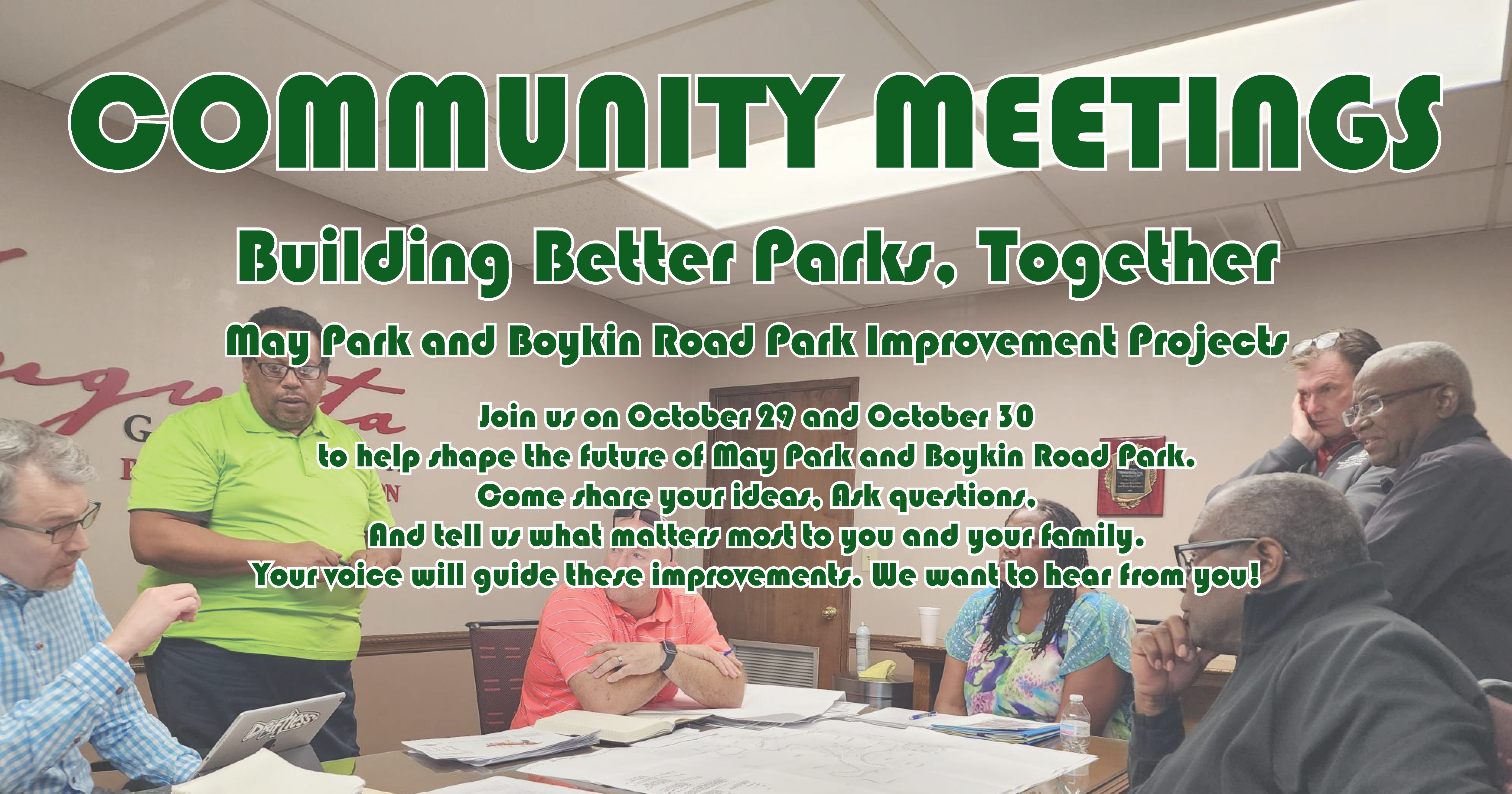
    Big things are happening in Augusta’s parks and we want you to be part of the process! The Augusta Recreation and Parks Department is inviting residents to help shape the future of May Park and Boykin Road Park. Both projects are funded by the State of Georgia through the INODIC grant, bringing exciting opportunities to upgrade and reimagine two of our community’s most beloved outdoor spaces.

    Reimagining May Park

    Nestled in the heart of Augusta, May Park has been a favorite gathering place for generations, a hub for family picnics, youth sports, and community celebrations. Now, it’s time for a refresh!

    Proposed improvements include:

    • Expanded parking for easier access to events and recreation
    • A new connector to Magnolia Cemetery, enhancing walkability and historic connectivity
    • A new shelter with restrooms for added convenience
    • Upgraded walking trails and a dedicated fitness area for all ages
    • More playspace for kids to laugh, run, and explore
    • Improved tennis and basketball courts
    • And a variety of community-centered features designed to make May Park a welcoming destination for everyone

    Join us at the Public Involvement Meeting on Wednesday, October 29, 2025, at 6:00 p.m. at May Park Community Center (622 4th Street, Augusta, GA 30901).

    Your feedback will help ensure that May Park continues to grow as a vibrant, inclusive community space – built by the people who use it most.

    Revitalizing Boykin Road Park

    In south Augusta, Boykin Road Park is also ready for its next chapter. Thanks to the INODIC grant, this project will focus on blending nature, play, and wellness in creative ways.

    Proposed features include:

    • Parking lot upgrades and improved access points
    • A fitness area and walking trails perfect for an afternoon workout or family stroll
    • A playground with a waterplay feature, not a traditional splash pad, but something that encourages imaginative outdoor play (think puddles, mudpies, and creative fun!)
    • A community garden where neighbors can grow together
    • Picnic shelters and restrooms for comfort and convenience
    • And additional enhancements to make Boykin Road Park a true neighborhood treasure

    We invite residents to share their ideas at the Public Involvement Meeting on Thursday, October 30, 2025, at 6:00 p.m. at Gracewood Community Center (2309 Tobacco Road, Hephzibah, GA 30815).

    Why Your Voice Matters

    These meetings aren’t just about plans and maps, they’re about people. Your input helps shape how these parks will serve Augusta families for years to come. Whether you’re a parent who knows what makes a great playground, a fitness enthusiast with ideas for trail design, or simply someone who loves your neighborhood park, your feedback is vital.

    Come ready to share your thoughts, dreams, and ideas. Together, we can build parks that reflect the heart and spirit of Augusta.

    We also welcome your comments and feedback online. Tell us what features matter most to you and your family!

  • Why Youth Basketball Is More Than Just a Game

    There’s something timeless about the sound of a bouncing basketball echoing through a gym on a cool winter evening. The rhythmic dribble, the squeak of sneakers, the swish of the net, and the cheers from parents in the stands all blend together into something bigger than sport. It’s community. It’s growth. It’s joy.

    Each year, hundreds of young athletes from across Augusta lace up their shoes and step onto the court for another exciting season of youth basketball with Augusta Recreation and Parks. To many of them, it’s a highlight of the year, a chance to play, compete, and belong. To parents, it’s a powerful opportunity to watch their children discover their potential.

    But youth basketball isn’t just about throwing hoops. It’s about building confidence, character, and connection, qualities that last long after the final buzzer.


    The Lasting Value of Youth Sports

    In a world where kids are often pulled toward screens and social media, youth sports bring balance, discipline, and friendship back into their lives. When children join a team, they join something that challenges their bodies and their minds. They learn to listen, to cooperate, to take turns, and to celebrate not only their own victories but those of others.

    Playing basketball keeps kids active, healthy, and engaged, but it also keeps them hopeful. It reminds them that effort matters, that improvement is possible, and that growth comes from practice, not perfection.

    For parents, it offers a front-row seat to one of the most rewarding transformations: watching a shy child find their voice on the court, or seeing a quiet player step up to encourage a teammate. Youth sports create stories of resilience and pride that families carry for years.


    Lessons Beyond the Game

    Every pass, every missed shot, and every small success is a teaching moment. Kids learn to show up on time, to pay attention, and to respect their coaches and teammates. They begin to understand that persistence pays off, that the skills that seem impossible one week can become second nature the next.

    They also learn to face challenges with courage. Basketball teaches that losing a game doesn’t mean losing heart, that frustration can fuel improvement, and that respect for opponents is part of true sportsmanship. These are lessons that prepare them not only for sports but for life’s larger arenas: school, work, and relationships.

    Confidence grows naturally from these experiences. A child who believes in their ability to handle the pressure of a close game learns they can also handle the pressures of school, friendships, and future goals. That sense of accomplishment builds from the inside out.

    What Makes Augusta’s Program Special

    The Augusta Recreation & Parks Department takes pride in offering a program that’s about much more than competition. It’s about community. It’s about inclusion. It’s about the belief that every child deserves the chance to learn, play, and grow in a positive environment.

    Our youth basketball program welcomes boys and girls ages five through seventeen, and it focuses on teaching fundamentals while building teamwork, discipline, and self-respect. Practices are designed to be engaging and educational, helping players develop both athletic and interpersonal skills. The games are exciting but fair, ensuring that every player (regardless of experience) has the chance to contribute and improve.

    Our coaches are mentors who care deeply about each player’s progress, both on and off the court. Many are community members who once played in the same program and now return to give back to the next generation. That local pride runs deep, and it’s what makes the Augusta Recreation program stand out year after year.

    The energy inside our recreation centers during basketball season is contagious. You can feel it in the laughter during drills, the encouragement from the sidelines, and the shared excitement when a player makes their first basket. Each game becomes a neighborhood event, a gathering of families, friends, and community members cheering on Augusta’s future.

    The Ripple Effect of Participation

    When children participate in organized sports, the benefits ripple through every part of their lives. They perform better academically because sports teach focus and responsibility. They develop healthier habits that last into adulthood. They build friendships that cross schools and neighborhoods. And they learn that success is not about being the best – it’s about giving your best.

    Parents often notice the difference within just a few weeks. Children start showing more confidence, taking more initiative, and displaying better communication skills. They become more resilient, more respectful, and more engaged. They come home tired, happy, and proud.

    And perhaps most importantly, they begin to see themselves as part of something bigger. A team, a community, a shared purpose!


    Join the Team. Build the Future.

    The winter season of Augusta Youth Basketball is now open for registration, and there’s never been a better time to get involved. Every winter, our gyms come alive with the excitement of young athletes discovering what they’re capable of, and this season promises to be one of the best yet.

    If your child has ever picked up a basketball, if they’ve ever watched a game and imagined themselves on the court, or if you’ve been looking for a way to help them stay active and connected, now is the perfect time.

    When you sign your child up, you’re not just registering for a sport, you’re investing in their growth, their confidence, and their future. You’re helping them develop skills that reach far beyond basketball: teamwork, determination, empathy, and pride in their community.

    The memories made on the court, those Friday night games, those moments of cheering from the bleachers, those high-fives after a hard-fought win, will stay with them forever. These experiences shape character in ways no textbook or screen ever could.

    The Augusta Recreation & Parks Department is proud to make that opportunity accessible to families across our city. We invite you to take that step today. Encourage your child to play, to learn, to dream, and to grow through the game of basketball.

    Registration for the Winter Youth Basketball Season is underway now. Visit augustaga.gov/3223/Youth-Athletics to learn more and sign up before spaces fill.

    Because basketball in Augusta isn’t just about dribbling and shooting – it’s about belonging. It’s about learning who you are, finding your place, and realizing that every child, on every team, matters.

    And when your child steps onto that court for the first time, you’ll see it too: basketball is so much more than a game. It’s a chance to grow, together.